How Much House Can I Afford in Stockton's Higher-End Neighborhoods?
How much house you can afford in Stockton's higher-end neighborhoods (places like Brookside, Spanos Park, Quail Lakes, and the newer developments around 95219 and 95209) comes down to five things: your income, your monthly debts, your down payment, current interest rates, and the monthly payment you're actually comfortable living with. A lender turns the first four into a maximum loan amount. The fifth, the payment that still lets you breathe, is the number that should really guide your search.
TL;DR: In many cases, lenders look for your total housing payment to land around a third of your gross monthly income, and your total debts (housing plus car loans, student loans, and credit cards) to stay under roughly 43%, though the exact limits vary by loan program and lender. In Stockton's pricier pockets, your real budget also has to account for HOA dues, possible Mello-Roos assessments on newer construction, higher property taxes on a higher purchase price, and, above certain price points, a jumbo loan with its own rules. Confirm every one of those numbers with a licensed lender before you set a budget. The smartest first move is a pre-approval, so you're shopping with a real number instead of a guess.
This guide covers the five drivers, the difference between what you qualify for and what you should actually spend, how PITI works, and the extras that quietly shape a budget in Stockton's higher-end areas. Jeremiah Patterson is a San Joaquin County real estate agent focused on move-up buyers, relocations, and out-of-state moves, and this is the exact conversation he has with buyers, especially families relocating from the Bay Area, before they ever tour a home.
Start With the Difference: Qualify-For vs. Comfortable-With
There are two very different numbers in home buying, and confusing them is where a lot of stress begins, especially at higher price points, where the gap between them gets wider.
The first is what you qualify for, the maximum a lender will approve based on your income, debts, credit, and down payment. It's a ceiling. The second is what you're comfortable with, the monthly payment that still leaves room for savings, childcare, groceries, a car repair, and a life outside your mortgage.
In most cases, those two numbers are not the same. A lender might approve a payment that fits their formula but would leave you feeling stretched every month. In Stockton's higher-end neighborhoods, that temptation is real: a slightly bigger home in Brookside or a newer build in Spanos Park is easy to justify when the approval letter says you can. That's the gap Jeremiah Patterson watches for with move-up buyers who feel trapped by higher interest rates, the goal isn't the biggest house you can be approved for, it's the right house at a payment that feels calm five years from now. Precision beats panic.
A practical approach: get pre-approved to learn your ceiling, then set your own budget below it based on the monthly payment you actually want to live with.
The Five Drivers of What You Can Afford
Everything a lender calculates flows from five inputs.
1. Your Income
Lenders generally look at your gross (pre-tax) monthly income, from salary, self-employment, bonuses, commissions, and sometimes other stable sources. Steady, documentable income matters most. If you're self-employed or your pay varies, lenders typically average it over a couple of years, so it helps to have paperwork organized early. Bay Area buyers relocating to Stockton often carry strong incomes, but if a chunk is bonus or commission, a lender may weigh it differently than base salary, worth asking about early.
2. Your Debts and DTI
Your debt-to-income ratio (DTI) is the single most important number after income. It's your total monthly debt payments divided by your gross monthly income, expressed as a percentage.
Lenders usually look at two versions:
- Front-end (housing) ratio, your proposed housing payment as a share of income. Many lenders like to see this around 28, 33%, though it varies.
- Back-end (total debt) ratio, housing plus all other monthly debts (car loans, student loans, minimum credit-card payments, personal loans). This commonly needs to stay under about 43%, though some programs allow higher with strong compensating factors.
Here's what many buyers don't realize: paying down a car loan or credit card before you apply can meaningfully raise how much home you qualify for, because it lowers your DTI, a swing a lender can model for your exact situation.
3. Your Down Payment
Your down payment does three things at once: it reduces what you borrow, it can help you avoid or reduce mortgage insurance, and a larger one generally lowers your monthly payment.
Common down payment ranges you'll hear about:
- Conventional loans, often as low as 3, 5% down for qualified buyers, though putting down 20% typically avoids private mortgage insurance (PMI).
- FHA loans, commonly around 3.5% down, popular with first-time buyers, though FHA limits may not stretch to the top of Stockton's higher-end range in every case.
- VA and USDA loans, may allow qualified buyers to purchase with little or no down payment (VA for eligible veterans and service members; USDA for eligible rural areas near Stockton's edges).
On a pricier home, the 20%-down threshold is a bigger dollar figure, so many higher-end buyers weigh putting more down to avoid PMI against keeping cash in reserve. Don't forget closing costs, separate from the down payment and often a few percent of the price, real money at a higher price point. Keep reserves rather than draining every account; a local lender can tell you which programs fit.
4. Interest Rates
Rates are the driver you don't control, and the more you're borrowing, the more each fraction of a point moves your payment. When rates rise, the same monthly payment buys a smaller loan; when they ease, your buying power stretches back out.
Because rates move, any payment estimate is a snapshot. Get current numbers from a lender rather than relying on figures you saw months ago. Some buyers also explore rate buydowns or different loan structures, worth asking about, but run the specifics past the professionals handling your loan.
5. The Payment You're Comfortable With
This is the driver you fully control, and it deserves as much weight as the other four combined. Before you look at any lender's maximum, ask what monthly number feels sustainable given your other goals, retirement savings, kids' activities, travel, or simply not feeling house-poor. Sketch out your full monthly budget with the new payment plugged in, including the HOA dues, taxes, and assessments common in Stockton's higher-end areas, and see whether it still leaves breathing room. If it feels tight on paper, it will feel tighter in real life.
Understanding PITI: The Real Monthly Payment
When people picture a mortgage payment, they often think only of principal and interest. Your actual monthly housing cost is usually PITI:
- Principal, the portion that pays down your loan balance
- Interest, the cost of borrowing
- Taxes, property taxes, usually collected monthly into escrow
- Insurance, homeowners insurance, also commonly escrowed
If your down payment is under 20% on a conventional loan, add mortgage insurance (PMI). And in Stockton's higher-end neighborhoods, you often add HOA dues and, on some newer developments, Mello-Roos assessments on top, which is why two homes at the same price can carry very different monthly costs. Let's look at those local pieces.
The Extras That Matter in Stockton's Higher-End Areas
A budget built on purchase price alone misses the costs that make these neighborhoods what they are. Here's what to fold in, and confirm each with the professionals handling your transaction, since every one varies by home.
HOA Dues in Brookside, Spanos Park, and Quail Lakes
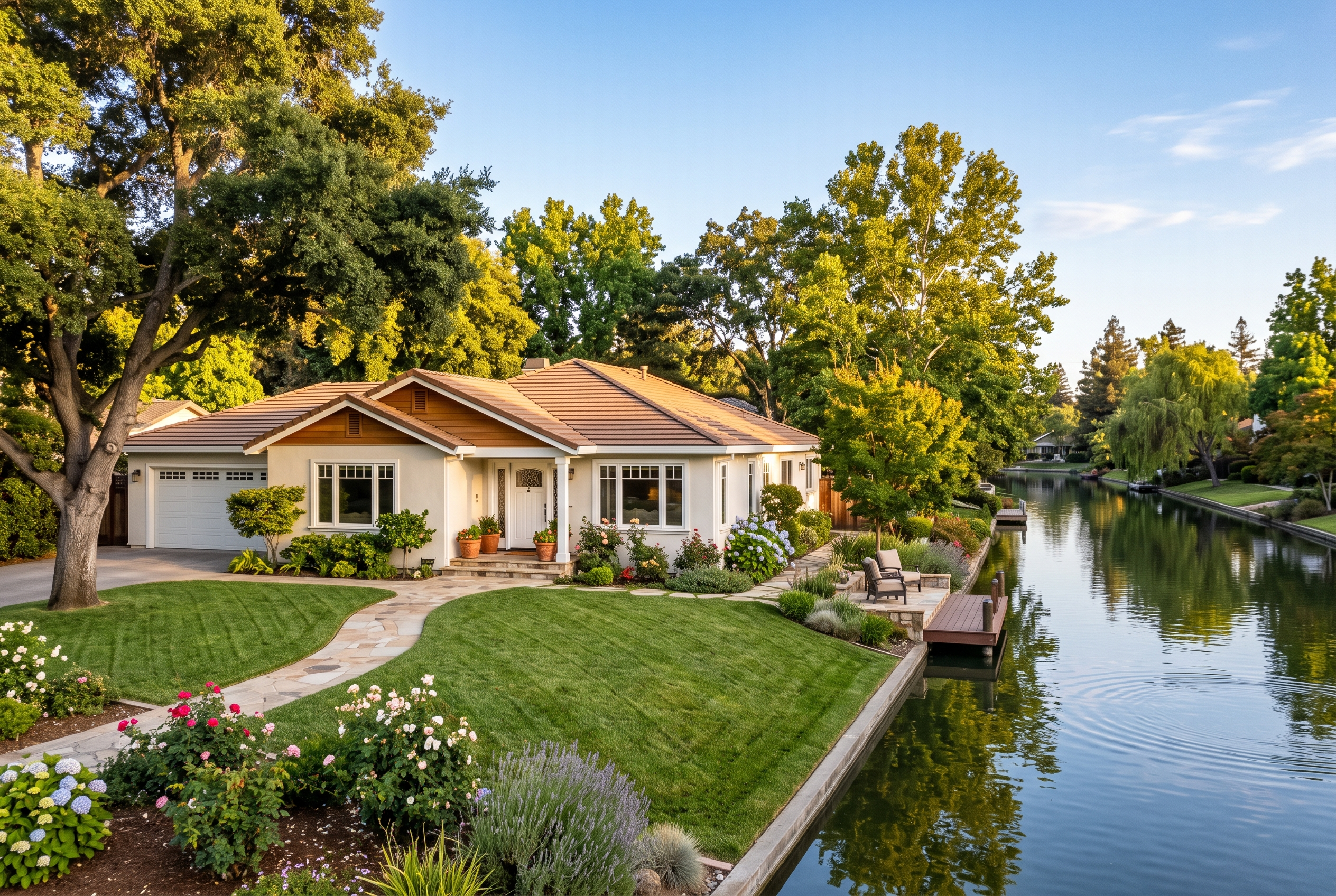
Many of Stockton's higher-end communities are planned developments with a homeowners association, and the dues are a monthly cost on top of PITI. Master-planned areas like Brookside (around 95219), Spanos Park (around 95209 and 95219), and Quail Lakes (around 95207 and 95219) often carry HOA dues funding landscaping, gated entries, private lakes or waterways, common areas, or recreation, and gated, waterfront, condo, or townhome developments carry higher dues than others.
Amounts vary widely, so ask for the current HOA figure on any specific home and read what it covers. A lower list price with high dues can cost more per month than a higher-priced home with modest dues. Lenders also count HOA dues in your housing ratio, so a hefty due can quietly lower how much home you qualify for.
Mello-Roos on Newer Developments
Some of Stockton's newer subdivisions, recent construction on the edges of Spanos Park and other newer pockets in 95209 and 95212, carry Mello-Roos community facilities district taxes or special assessments. These fund infrastructure like roads, schools, and parks, and are typically added to your annual property tax bill for a set number of years.
Mello-Roos is easy to overlook because it doesn't show up in the list price, but it can add a meaningful amount to your real monthly cost. If you're looking at newer construction, ask specifically whether it applies, how much it is, and how long it lasts. The county and your title company can confirm.
Higher Property Taxes on Pricier Homes
California property taxes are governed by Proposition 13, which generally sets the base rate at about 1% of assessed value, plus local voter-approved bonds and assessments that can push the effective rate somewhat higher. Because the rate is a percentage, a higher-priced Stockton home simply carries a larger tax bill, a home twice the price generally carries roughly twice the base tax.
One thing higher-end buyers especially need to know: your assessed value generally resets to the purchase price when you buy, so the prior owner's tax bill, often set years ago at a lower value, may not reflect yours, and on a move-up purchase that reset can be a real jump. Ask your lender or title company for an estimate based on your purchase price, not the current tax roll, and remember Mello-Roos may sit on top. The San Joaquin County Assessor can confirm specifics for a given parcel.
Homeowners Insurance
Insurance is a bigger line item than it used to be across California. Costs vary by the home's age, roof, systems, square footage, and coverage level, and a larger, higher-end home generally costs more to insure simply because there's more to rebuild. Homes near Stockton's waterways or in flood-mapped areas may also need flood insurance, which is separate from a standard homeowners policy. Get a quote early, ideally before you're in contract, so the premium doesn't surprise your monthly budget, and confirm both the homeowners premium and whether flood coverage applies with a licensed insurance professional.
Jumbo-Loan Basics for Higher Price Points
Above a certain loan amount, the conforming loan limit set each year for the county, a mortgage becomes a jumbo loan, which generally follows stricter rules. At the top of Stockton's higher-end range, especially for buyers putting less down, a jumbo loan is a real possibility, though whether you cross that line depends on the price, your down payment, and the current year's limit.
Jumbo loans commonly ask for a larger down payment, stronger credit, more cash reserves, and more documentation, and may carry different rates. That's not a reason to avoid a higher price point. It's a reason to talk to a lender early. Treat every jumbo detail here as a starting point to verify, since the specifics change year to year.
How Stockton Neighborhoods and ZIP Codes Shape Your Number
Stockton isn't one single market, and where you buy shapes what your budget gets you. The higher-end pockets each have their own feel and price range.
- 95219, the northwest, home to Brookside and parts of Spanos Park, with master-planned communities, gated enclaves, and waterfront living along the delta.
- 95209, north Stockton, including Spanos Park and newer subdivisions, generally newer construction where Mello-Roos is more likely to appear.
- 95207, central-north Stockton, including the established Quail Lakes area with its private lake and mature, sought-after streets.
- 95212, the northeast edge, with newer developments and a more open, semi-rural feel toward the county line.
A fixed budget might buy a larger, newer home with HOA dues and Mello-Roos in one pocket and a more established, lower-carrying-cost home in another. Knowing your comfortable monthly number first lets you focus where that number actually fits, extras included. Families weighing schools should confirm attendance areas, since Stockton is served by multiple districts, including Lodi Unified across much of north Stockton and Stockton Unified elsewhere, and assigned schools can differ block to block.
Buying in Stockton as a Bay Area Move-Up or Relocation Buyer
A big part of Stockton's appeal is that your dollar generally stretches further here than in the Bay Area, while staying within reach of it via I-5, Highway 99, the Altamont corridor, and the ACE train toward the Tri-Valley. For relocation and out-of-state buyers, this is often the "aha" moment: the same budget that felt tight closer to the coast can open up a Brookside, Spanos Park, or Quail Lakes home (square footage, a newer build, or a waterfront lot that wasn't on the table before. Just factor commuting costs) gas, tolls, transit, and time, into your monthly picture, and fold in HOA dues and any Mello-Roos, so you're comparing the full number, not the sticker price.
This is a conversation Jeremiah Patterson has often with move-up and relocating buyers who want more home without overextending. He's lived the move-up path himself, going from a 2-bedroom fixer to a 4-bedroom updated home, so he understands both the stretch and the reward. It's a core part of his Carefree Home Buying Process: think two steps ahead so the whole picture fits, not just the purchase price.
A Simple Way to Estimate Your Number
You don't need a spreadsheet to get a rough sense of your range. In general terms: find your gross monthly income (pre-tax), estimate a comfortable housing payment (many buyers start around 28, 33% of income, then adjust down if their goals need room), subtract your other monthly debts to keep total DTI in a lender-friendly range (often under about 43%), then back into a price remembering the payment must cover PITI plus any HOA dues, Mello-Roos, and PMI. Confirm with a lender, because your rate, program, down payment, and whether the loan is conforming or jumbo all change the math. Treat your own estimate as a starting frame and the pre-approval as the real answer, especially where the extras add up.
Common Mistakes Stockton Higher-End Home Buyers Make
Shopping Before Getting Pre-Approved
Touring homes before you know your number leads to falling for houses outside your range, or missing out because you weren't ready to make a strong offer. A pre-approval turns your budget from a guess into a real, sellers-take-it-seriously figure, which matters more where competition can be strong.
Budgeting on Price Instead of Monthly Payment
Two homes at the same price can cost very different amounts per month once taxes, insurance, HOA dues, Mello-Roos, and PMI are added. In Brookside, Spanos Park, and Quail Lakes especially, and with newer construction in 95209 and 95212, the dues and assessments can be the deciding factor. Always compare the full monthly PITI, not just the list price, and confirm exactly what any HOA dues cover.
Forgetting Closing Costs, Reserves, and the Tax Reset
Draining every account to maximize the down payment leaves no cushion for moving costs, repairs, or surprises, and jumbo loans often require reserves. Closing costs are separate from the down payment, and a few percent of a higher price is a meaningful sum. Remember, too, that your assessed value generally resets to what you pay, so a low tax figure on the current listing may not reflect your bill, ask for an estimate based on your purchase price.
Maxing Out the Approval
Just because a lender approves a number doesn't mean you should spend it. Buying at the very top of your approval leaves no room for rate changes or shifts in your budget. Comfort beats ceiling, in a higher-end home, that discipline is what keeps the dream house from feeling like a burden.
Frequently Asked Questions About Affording a Home in Stockton's Higher-End Neighborhoods
How much income do I need to buy in Brookside, Spanos Park, or Quail Lakes?
It depends on the price, your down payment, current rates, your other debts, and the home's HOA dues and any Mello-Roos, so there's no single figure. In many cases, lenders look for your total housing payment to sit around a third of your gross monthly income. Because these neighborhoods carry extra monthly costs, the most reliable way to find your number is a pre-approval with a local lender.
Do HOA dues affect how much house I can afford?
Yes. Lenders generally count HOA dues in your housing payment, so higher dues can lower the loan amount you qualify for, and they're a real monthly cost on top of PITI. Ask for the current dues on any specific home and what they cover.
What is Mello-Roos, and does it apply in Stockton?
Mello-Roos is a special tax that funds infrastructure like roads, schools, and parks, typically added to your annual property tax bill for a set number of years. It's more common on newer developments, some of which sit in north and northeast Stockton (95209 and 95212). Ask whether it applies to a specific parcel, how much it is, and how long it lasts, the county and title company can confirm.
Will I need a jumbo loan for a higher-end Stockton home?
Possibly, depending on the price, your down payment, and the current year's conforming loan limit for the county. Above that limit, the loan is considered jumbo and generally follows stricter rules on down payment, credit, and reserves. A lender can tell you early whether you're in conforming or jumbo territory.
How much are property taxes on a pricier Stockton home?
Proposition 13 generally sets a base rate near 1% of assessed value, plus local voter-approved items and any Mello-Roos. Because it's a percentage, a higher-priced home has a larger tax bill, and your assessed value usually resets to your purchase price when you buy. Ask for an estimate based on what you'll pay rather than the current owner's bill.
Should I buy at the top of what I'm approved for?
Generally, no. Your approval is a maximum, not a recommendation. Many buyers are happier setting their budget below the ceiling so the monthly payment, including all the higher-end extras, leaves room for savings and everyday life.
Ready to Find Out What You Can Afford in Stockton?
You don't need every number figured out to get started. A good first step is three:
- A pre-approval conversation with a trusted local lender to learn your real range, and whether you're in conforming or jumbo territory
- A clear sense of the monthly PITI payment, including HOA dues and any Mello-Roos, that you're genuinely comfortable with
- A look at which Stockton neighborhoods and price points fit that number
Jeremiah Patterson is a real estate agent in San Joaquin County who helps move-up buyers, first-time buyers, and relocating families find the right home at a payment that feels calm, across Stockton, Lodi, Woodbridge, Acampo, and Galt. With experience since 2016, a 5.0 rating across verified client reviews, and Masters Club Lifetime Member recognition, his philosophy comes down to one idea: your dream life is closer than you think, and it starts with knowing your real number, extras included, not just your maximum.
Jeremiah Patterson Cornerstone Real Estate Group Phone (209) 329-7238 Email jeremiah@sellingsanjoaquin.com CA DRE #02017640 experience since 2016
Categories
Recent Posts







GET MORE INFORMATION